Features / It keeps improving / Your growth manager
Knows your business. Does the work. Brings you decisions, not chores.
Your digital growth manager learns what a customer is worth to you, agrees a mandate with you, and runs your ads inside it every day. When something is genuinely your call, it comes with a recommendation and a number. Nothing goes live until you say so.
Free to start. No credit card. Nothing goes live until you say so.
Three things people say about their ads. And what changes.
“I pay for ads every month and I honestly couldn’t tell you what the money did.”
What changes
It reports against what you agreed together: customers won, what each one cost, against the ceiling you set. In your terms, not the platform’s. Ask a question and get a straight answer in money.
“Every tool I’ve tried sends me a list of things to do. I hired it so I wouldn’t have to.”
What changes
It handles what you have mandated and tells you after. What is left for you is a recommendation with a reason, a number and one button. Never more than three at a time. Some weeks, none.
“I don’t trust something I can’t see to touch my budget.”
What changes
You write the mandate: the cap, the cost ceiling, what it may do alone, what always comes to you. The cap is enforced in code. You widen the mandate when it has earned it, not before.
The way a good advisor works with a serious business.
Not a dashboard with opinions. A professional with a brief.
01
Learns the business first.
Before it touches anything: what you sell, what a customer is worth, what you are trying to do this quarter, and what is off limits. It reads your accounts and your website, and asks only what it cannot read.
02
Agrees a mandate.
A monthly cap. A cost per customer it must stay under. What it may do without asking, and what always comes to you. Written down, one screen, changed in one line.
03
Brings decisions, not chores.
When something is your call, you get a recommendation, the reason, the money, and what it would do instead. One button for yes. One line for no. It does not nag, and it does not send a list.
04
Owns the result.
Every recommendation says what it expects, from your own numbers. A week later it tells you what actually happened, including when it was wrong. It names its misses before you find them.
Two decisions. One minute. The rest is handled.
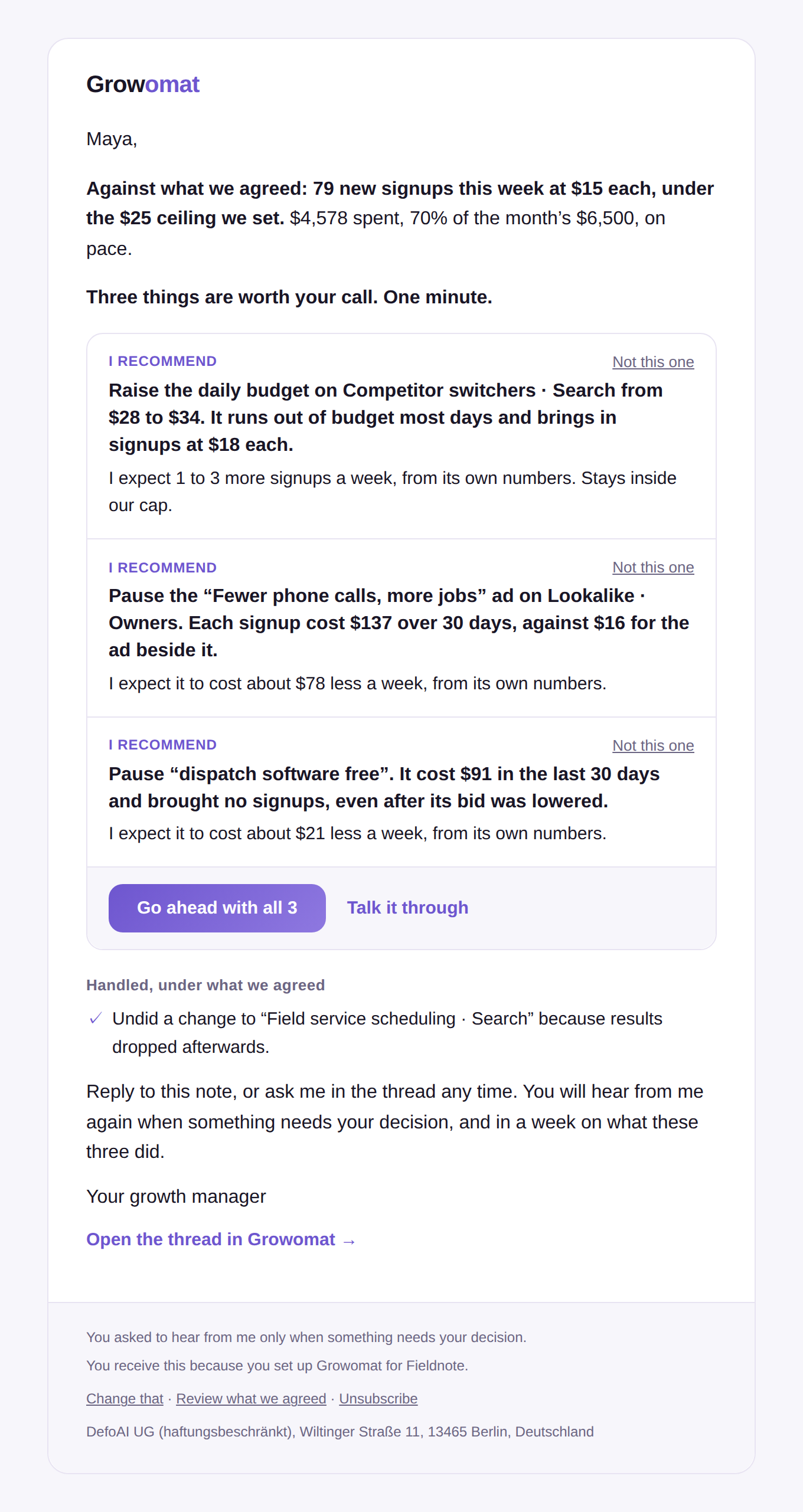
This is the whole note, as it lands. Nothing in it needs a login, and nothing in it is a task for you.
Opens against the brief
Customers won and what each cost, against the ceiling you agreed. Not impressions. Not a chart.
Recommends, with the number
“I recommend”, the reason, what it expects, and that it stays inside the cap. Go ahead is one button. “Not this one” is a link, not a form.
Reports what it handled
Inside the mandate it acts first and tells you after, in one line each, with the money. Nothing is hidden in a log.
Tells you what it is watching
The thing that is not a problem yet. So the next note is never a surprise, and neither is the bill.
You write the brief. It works inside it.
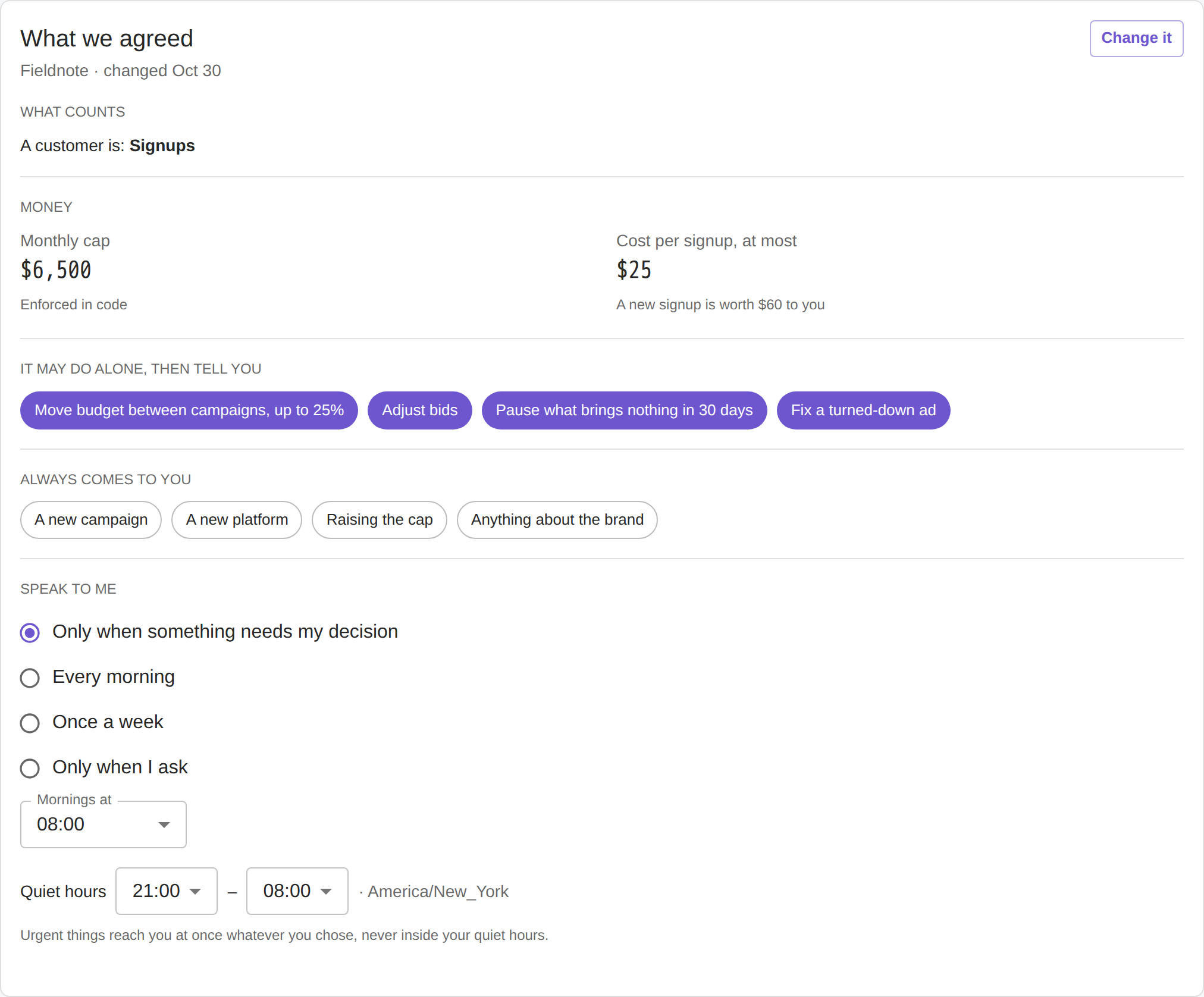
One screen says what it may do alone, what always comes to you, and when it should speak. Every workspace starts with everything coming to you. Widen it when it has earned it.
The cap and the ceiling are enforced in code. It cannot spend past them.
Change any line by telling it in the thread. “Keep LinkedIn Ads under $50 a day” is enough.
Urgent things reach you at once whatever you chose, never inside your quiet hours.
Starts with everything coming to you. Ends wherever you say.
It recommends. You say go.
Every change comes as a recommendation with its reason and its money. One button applies all of them. This is where every workspace starts, and where Advisor stays.
It acts inside the mandate. Then tells you.
Budget moves, bids, pausing what brings nothing. Inside the cap and the ceiling, enforced in code. Every move is named, and one that made things worse is reverted within 48 hours.
The big calls stay yours.
A new campaign, a new platform, a bigger cap, anything about the brand. Those come to you as a recommendation, however wide the mandate.
Acting on its own, your growth manager optimizes campaigns on all six platforms. Applying a platform’s own recommendations is available on Google Ads and Microsoft Advertising only. Reddit Ads, LinkedIn Ads and ChatGPT Ads have no recommendations API, and Meta Ads is planned.
What it will not do.
A good advisor is defined as much by what they refuse to do. Here is the line.
Spend past the cap.
The monthly cap and the cost ceiling are enforced in code, not policy. It cannot spend past them, however wide the mandate.
Take credit it did not earn.
Money found counts only when it is arithmetic: spend that bought nothing, stopped, counted at what it was spending. A good week it did not cause stays yours.
Tell you what you want to hear.
If a change of its made things worse, it says so first. If it cannot measure something, it says it cannot measure it. A projection is labelled a projection.
Nothing goes live until you say so.
Wherever you already are. Same thread, same memory.
In the app
The thread, the plan for the next 30 days, and the mandate. Your whole team sees the same conversation.
By email
Its notes and anything urgent. Say go from the email, or reply to it like a colleague. Anyone on the team who can edit can say go.
Questions people ask first.
As often as you say in the mandate: only when something needs your decision, every morning, once a week, or only when you ask. Urgent things reach you at once whatever you chose, never inside your quiet hours.
Not until you say so. Every workspace starts with every change coming to you as a recommendation. On Manager and Scale you can mandate it to act on its own inside the cap and the ceiling, and it names every move it made.
Say “not this one” and tell it why, in a line. It remembers, and it will not bring the same thing back. If it still thinks you are wrong, it will say so once, with the number, and then leave it.
Only arithmetic. Spend that brought no booking, sale or enquiry over 30 days, stopped, counted at what it was spending per month. A platform’s own projected saving is shown as a projection. A change of its that made things worse is named, not buried.
Yes. There is one thread per workspace, shared by everyone in it. Anyone who can edit can say go; everyone sees what was done and who said so.
Related features
Brief it tonight. Its first note is in your inbox tomorrow.
What it found in your accounts, what it recommends, and what it would do first. From $199 a month after your free first month, flat, never a share of your spend.
Free to start. No credit card. Nothing goes live until you say so.